

Key Takeaways
Dentists do use light regularly, but “UV light” and dental curing light are not interchangeable terms. The wavelength, material, dose, and safety controls all determine what a device is designed to do.
- Most modern composite fillings are cured with visible blue light, not ultraviolet light.
- Photoinitiators in dental materials respond to a specific wavelength range and start polymerization.
- UV-C devices may support disinfection in controlled settings, but they do not replace cleaning and sterilization.
- Dental laboratories use several light-based processes alongside CAD/CAM equipment and skilled technician review.
- Safe, consistent results depend on correct exposure, calibration, training, and protective measures.
How UV light is used in modern dentistry
So, do dentists use uv light? The short answer is sometimes, but the phrase often describes several different technologies. Ultraviolet radiation sits outside the visible spectrum, while many devices used in ordinary dental treatment emit visible blue light. Understanding that distinction makes it easier to see where light belongs in a clinical or laboratory workflow.
The difference between ultraviolet and visible blue light
Ultraviolet light has shorter wavelengths than visible violet and blue light, so people cannot see it in the same way. A traditional UV curing device and a modern blue-light curing unit may both harden a material, but they do so with different light sources and wavelength ranges. Calling every dental curing lamp a UV lamp can therefore create confusion about both performance and safety.
Why dental professionals select specific light wavelengths
Dental materials are formulated around photoinitiators that absorb particular wavelengths. A light source must overlap that absorption range with enough intensity to begin the intended chemical reaction. The goal is not simply to use the strongest available lamp; it is to match the source to the material while limiting unnecessary exposure and heat.
Where light-based technology fits into clinical workflows
In a practice, light may be used to cure restorative materials, set certain adhesives or cements, or support selected specialty procedures. The device is usually one step in a larger sequence that includes diagnosis, isolation, material placement, shaping, and finishing. A light cannot compensate for poor preparation, inadequate bonding technique, or a material that has been placed too thickly.
For professionals exploring the field, a practical dental lab technician career guide can help connect this technology with the wider work of designing, producing, and inspecting dental restorations.
How dentists balance performance with patient safety
Dentists consider the wavelength, intensity, exposure time, and distance between the tip and the restoration. They also use barriers, shields, and appropriate eye protection when the equipment calls for them. Correct technique matters as much as power, because a well-positioned light can deliver a predictable result without turning every procedure into a higher-exposure event.
Dental curing lights versus UV lights
Dental curing lights are often discussed as UV lights because early systems used ultraviolet radiation. Most contemporary curing units used for composite restorations instead rely on visible blue light designed to activate the photoinitiator in a resin. The difference is practical: the material, not the label on the lamp, determines which source is appropriate.
How composite fillings are hardened
A dentist places a light-curable composite in controlled increments, shapes it, and exposes each increment to the curing unit. The light activates a reaction that changes the resin from a workable material into a hardened restoration. Adequate curing supports the restoration’s intended mechanical properties, while incomplete curing can affect wear, strength, sensitivity, and long-term stability.
Why most curing lights use blue light
Blue light is effective for many resin systems because common photoinitiators absorb energy in the blue region of the visible spectrum. Modern LED units can provide a focused, repeatable output without requiring the operator to use ultraviolet radiation for routine composite placement. A useful overview of dental curing lights also explains how the technology moved from early UV-based devices toward visible blue-light systems.
What photoinitiators do inside dental materials
Photoinitiators are light-sensitive components mixed into resin-based materials. When they absorb the appropriate energy, they produce reactive species that start polymerization, linking smaller molecules into a solid network. Different composites, adhesives, and cements may use different initiator systems, which is why one curing setting should not automatically be assumed suitable for every product.
How curing distance, angle, and exposure time affect results
The tip should be positioned as close and as perpendicular to the restoration as the clinical situation allows. Angling the light or moving it too far away reduces the energy reaching the material, while an overly short exposure may leave deeper areas under-cured. Operators should follow the material and device instructions rather than relying on appearance alone.
A simple way to assess the variables is to separate them before each case:
- Confirm that the curing mode matches the material’s instructions.
- Check that the light tip is clean and close to the restoration.
- Keep the beam as perpendicular to the surface as the anatomy permits.
- Use the specified exposure time for the increment thickness.
These checks are small, but they make the process more repeatable. They also help a new clinician or technician understand why curing is a controlled procedure rather than a quick flash of light.
UV light applications in dental laboratories
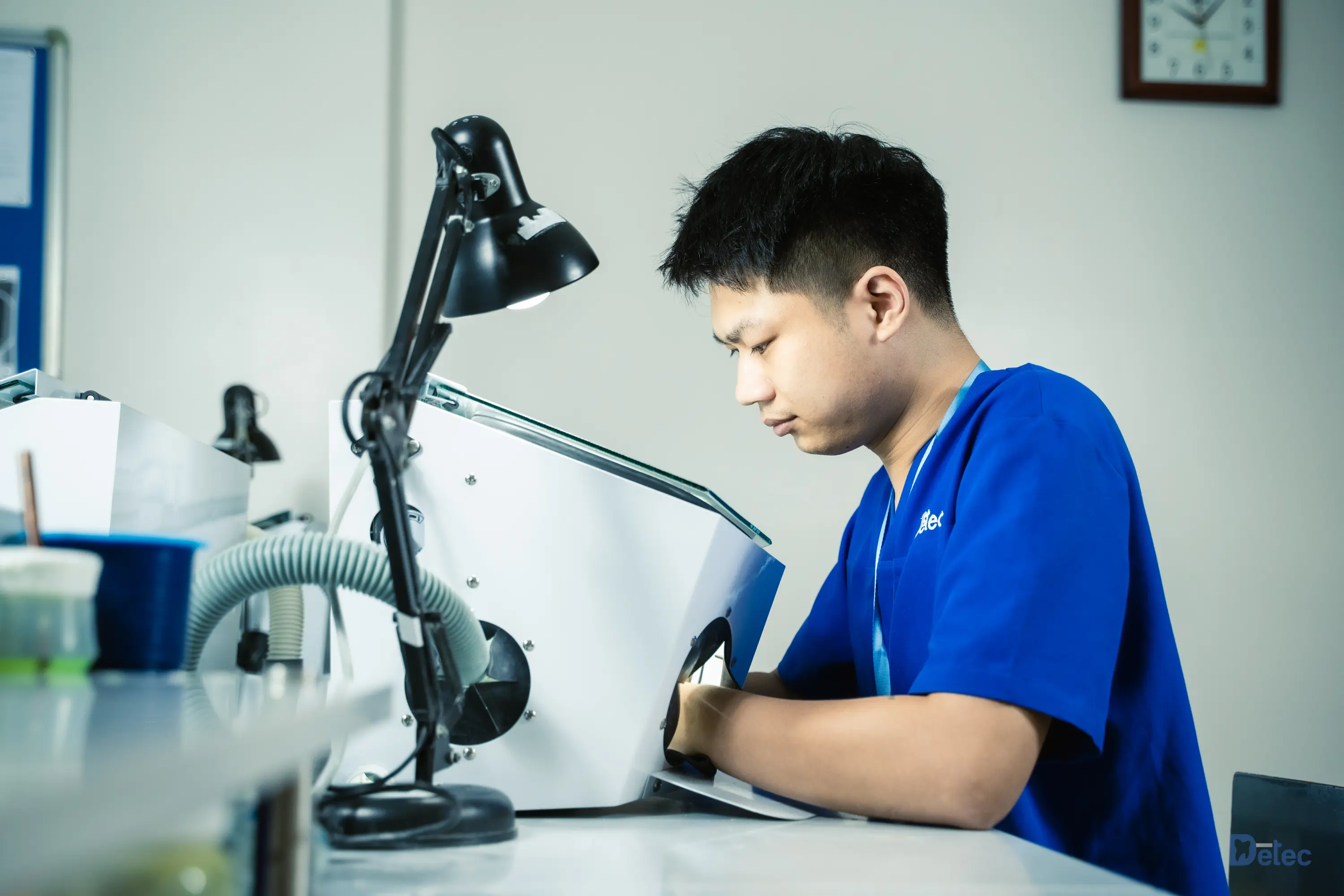
Dental laboratories use light in a broader manufacturing environment than a dental operatory. A technician may work with light-curable materials, model products, specialty appliances, or finishing processes, while also using scanners, design software, milling equipment, and inspection tools. The exact process depends on the material and the restoration being produced.
Curing and processing selected dental materials
Some laboratory materials are formulated to be shaped and then cured with a specified light source. Controlled exposure can help stabilize a component, set a coating, or complete a manufacturer-defined processing stage. Technicians still need to observe recommended thicknesses, handling times, and post-curing steps because light exposure is only one part of the material protocol.
Supporting digital CAD/CAM manufacturing workflows
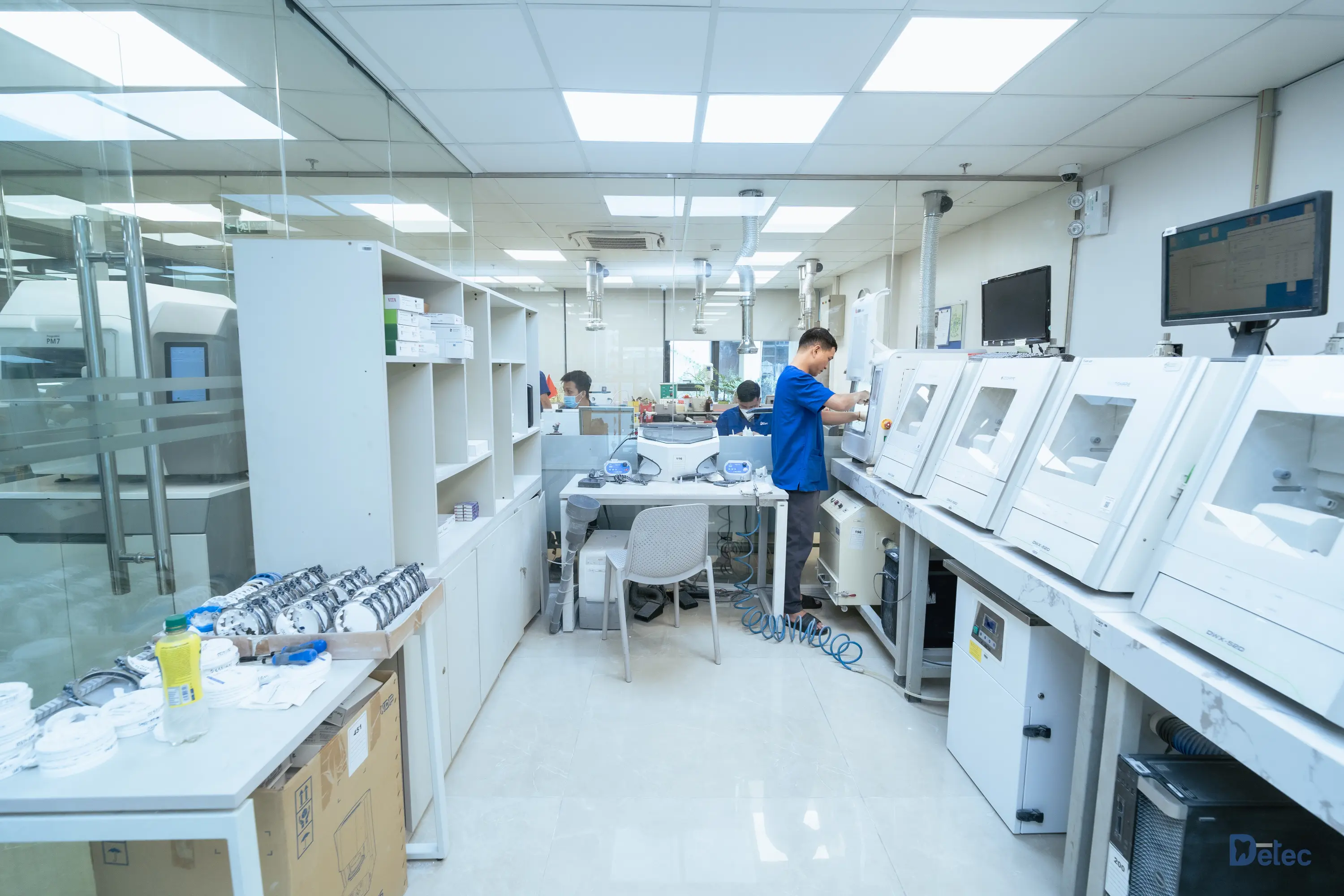
Light technology does not replace CAD/CAM; it complements it. A digital workflow may begin with a scan, continue through computer-aided design and approval, and then move to milling, printing, curing, finishing, and inspection. Detec Labs describes a fully digital laboratory environment using CAD/CAM milling, 3D scanning, and design software, showing how digital precision and hands-on judgment work together.
Using light technology for specialty appliances and restorations
The relevance of a light-based process varies by the appliance or restoration. A technician may need a particular wavelength, chamber, fixture, or exposure schedule for a selected resin or coating. It is better to identify the material’s validated process than to assume that a device used for one restoration can safely or effectively process another.
How trained technicians verify consistency and fit
After curing or processing, technicians inspect the result for surface quality, dimensions, margins, contacts, and fit on the model or digital reference. They may repeat a step, adjust a surface, or reject a component if it does not meet the case requirements. Detec’s nearly 30 years of experience and its dedicated Dental School reflect the broader principle that advanced equipment still depends on trained people who understand why each setting matters.
Does UV light sterilize dental instruments?
UV-C light can damage or inactivate microorganisms under suitable conditions, but that does not make every UV cabinet a sterilizer. Shadows, surface contamination, distance, dose, and exposure time can all limit what the light reaches. For instruments that enter sterile tissue, dental teams rely on validated cleaning and sterilization procedures rather than treating UV exposure as a shortcut.
How UV-C disinfection differs from sterilization
Disinfection reduces or inactivates many microorganisms on exposed surfaces, while sterilization is a validated process intended to eliminate all forms of viable microbial life, including resistant spores. UV-C is line-of-sight technology, so a shaded hinge or an obstructed surface may receive little or no effective dose. The distinction matters because a device’s marketing label does not establish that it can sterilize dental instruments.
Why cleaning and autoclaving remain essential
Instruments must first be cleaned to remove blood, saliva, and other debris that can shield microorganisms from a disinfectant or sterilizing agent. Depending on the instrument and applicable protocol, packaging and steam autoclaving may then be required. Cleaning, inspection, packaging, sterilization, and recordkeeping form a chain; skipping one link undermines the process.
When enclosed UV systems may support infection control
An enclosed UV system may have a supporting role for exposed surfaces or air, provided it is installed and operated according to its validated instructions. It should not be assumed to reach areas hidden behind instruments or equipment. Infection-control policies should identify exactly what the unit is approved to process and how staff verify its operating cycle.
Safety controls for staff, patients, and equipment
Direct UV-C exposure can injure skin and eyes, so enclosed designs, interlocks, warning labels, and access controls are important. Staff should never defeat a safety feature to keep a cycle running. The same cautious approach applies to electronics and materials that may degrade under repeated ultraviolet exposure.
Safety considerations for dental UV and curing light
Light-based equipment is useful because it delivers energy precisely, but precision requires control. UV-C and visible blue light have different hazards, and neither should be treated as harmless simply because the exposure is brief. Dental teams manage risk by following the device instructions, using protective equipment, and keeping the light directed only where it is needed.
How dental teams limit unnecessary exposure
Operators can reduce exposure by avoiding unnecessary activation, keeping the light aimed at the restoration, and using the shortest validated exposure that achieves the required cure. Routine checks also help identify damaged shields, cracked tips, or output changes. The American Dental Association’s curing-light safety guidance discusses the potential blue-light hazard and the value of suitable filtering protection.
Protective measures for eyes and skin
Protective shields, filtering eyewear, barriers, and enclosed chambers should be selected for the wavelength being emitted. Staff should position themselves so they are not looking directly into the beam, and patients should be protected when the clinical setup creates a possible line of sight. UV-C equipment requires especially strict controls because the radiation is invisible.
Why wavelength and dose determine risk
Risk depends on more than whether a lamp is called UV or blue. Wavelength, irradiance, exposure time, distance, beam geometry, and repeated occupational exposure all influence the dose received. A low-output source used briefly may present a different risk from a high-output source used repeatedly, but both still require the manufacturer’s safeguards.
When patients should ask about the equipment being used
Patients can reasonably ask what a light is being used for, whether it is a curing light or a disinfection device, and what protection is provided. A dental professional should be able to explain the purpose in plain language without making exaggerated claims. Clear answers are particularly helpful for patients with light sensitivity, eye conditions, or concerns about repeated exposure.
How dental practices and labs choose light-based technology
Choosing a light is not simply a matter of buying the most powerful model. Practices and laboratories compare the material requirements, workflow, ergonomics, service support, and safety controls. The right device is the one that fits a validated process and can be used consistently by the people responsible for the result.
Matching the device to the material and procedure
The first question is what the device must cure, disinfect, or process. Teams should check the material’s instructions, required wavelength, exposure range, chamber dimensions, and compatibility with the intended workflow. A curing unit for restorative composite is not automatically suitable for a laboratory resin, and a UV-C cabinet is not automatically a replacement for an instrument sterilizer.
Evaluating output, calibration, and maintenance
Output should be checked according to the manufacturer’s recommendations, with attention to the condition of the light guide, lens, filters, and power source. Calibration records help identify gradual decreases that may not be visible during a busy day. Maintenance also includes cleaning the tip, replacing worn components, and documenting corrective action when readings fall outside the accepted range.
The role of professional training and quality systems
Training turns a device specification into a reliable routine. Operators need to know how to position the light, interpret exposure instructions, protect themselves, and respond when equipment behaves unexpectedly. For teams comparing a laboratory partner, a quality dental lab selection guide can also prompt useful questions about technician training, digital workflows, communication, and quality assurance.
How advanced labs combine technology with technician expertise
A modern lab may combine 3D scanning, CAD/CAM design, milling, printing, curing, and manual finishing, but the final result still depends on inspection and clinical communication. Detec Training Center supports the industry through advanced courses and a certified partnership program, an example of why education remains central as workflows become more digital. If your practice is reviewing its laboratory workflow, you can explore lab services and compare the technical support, communication, and quality systems available for your cases.
Conclusion
Dentists and dental technicians do use light-based technology, but routine composite curing generally relies on visible blue light rather than UV light, while UV-C has a limited supporting role in controlled disinfection. Safe and predictable outcomes come from matching the wavelength and dose to the material, maintaining the equipment, and applying trained professional judgment throughout the workflow.
Frequently Asked Questions
Do dentists use UV light for fillings?
Most modern composite fillings are cured with visible blue light matched to the material’s photoinitiator, rather than ultraviolet light. Early curing systems used UV-based technology, which is one reason the terms are sometimes confused.
What does a dental curing light do?
A dental curing light activates photoinitiators in a light-curable material, starting polymerization and hardening the composite, adhesive, cement, or other compatible resin.
Is blue light the same as UV light?
No. UV light is outside the visible spectrum, while blue light is visible. Dental curing units may use blue light even though people sometimes refer to them broadly as UV lights.
Can UV light sterilize dental instruments?
UV-C may reduce microorganisms on directly exposed surfaces under controlled conditions, but it should not be assumed to sterilize dental instruments. Validated cleaning and sterilization procedures remain essential.
Why does curing-light distance matter?
As the light moves farther from the material, less energy reaches the surface. Angling the tip or obstructing the beam can also reduce the dose, potentially leaving deeper material insufficiently cured.
Should patients wear eye protection during light curing?
Eye protection or shielding may be appropriate when the beam could be seen directly. Dental teams should use protection suited to the device’s wavelength and explain any precautions needed for the procedure.
How do dental laboratories ensure light-cured work is consistent?
They follow material instructions, control exposure time and positioning, maintain equipment, inspect processed parts, and combine digital measurements with trained technician review before a case is released.


